Pages

Showing posts with label literary magazines. Show all posts

Thursday, February 24, 2011

How to Query a Literary Magazine

I have a client who writes very tight, literary short stories. He has not been able to place them yet with a literary magazine, however. I asked to see his cover letter so I could critique it for him. The cover letter he was using was so representative of many earnest unpublished authors and so full of typical well-meaning noob mistakes, I thought I would make my critique public. A lot of people struggle with content on a query when they have nothing to say about writing career, previous publications, seemingly nothing to say at all. This letter follows all the rules of writing a query, and yet it's squeaking with awkwardness. It screams "Ignore me; I'm new."

The first step to a successful pitch to a literary journal is to write the best short story or poem you can possibly write. Write, rest, rewrite, rest, edit, line edit, format sensibly, print clearly.

The second step is to do a hell of a lot of research. Wear out your Google searching your target markets. If you can afford it, buy and read the physical publications. You will know within ten pages if your work is a fit for their editorial vision. The best story in the universe will not make it past the front door of a magazine that just doesn't do that type of thing.

The third step is to write a bitchin' query letter, or cover letter, and stick it on top.

Here's the original letter he sent me:

February 1, 2011

Fiction Editor
The Georgia Review
The University of Georgia
Athens, GA 30602-9009

To Whom it May Concern,

Please consider my 1,200-word, previously unpublished manuscript, "[Title Redacted]" for publication at The Georgia Review. I am a previously unpublished writer, but I work with earnest on the craft. This piece is a part of a collection of stories that will one day comprise a novel.

This piece is being simultaneously submitted. I will notify you immediately upon an
acceptance.

Thank you for your time and consideration.

Sincerely yours,

[Name Redacted]

And here are my critiques:

1. Dude, find out the name of the editor you're addressing. It's not hard to do this research, especially with the internet. Even if you end up addressing it to someone more senior than the person who actually reads their slush, that's okay. It's better than "To Whom it May Concern." That is the kiss of death. For example, look here: http://www.uga.edu/garev/contact.html Out of the staff listed I'd choose David Ingle to query.

2. Don't say you're previously unpublished. The fact that you're not mentioning pub credits tells them that, and you don't need to draw attention to it. You also REALLY don't need to say that this story specifically is previously unpublished. Now you just put the words "previously unpublished" twice in as many sentences. Did you want to add a neon sign over that? ;D

3. Put a little more color into it. Personal color and literary color. You don't have a publishing resume but you can say something about yourself that makes your query sound a little warmer, a little less robotic.

4. Not necessary to say you're simultaneously submitting -- just let them know if it gets accepted elsewhere. Paper and ink literary magazines do not move at a blinding speed -- it will be alright if something good happens somewhere else and you have to withdraw the submission for some reason.

5. It's good to thank the editor, but yours sounds very formal and therefore insincere.

Try this:

February 1, 2011

David Ingle
Assistant Editor
The Georgia Review
The University of Georgia
Athens, GA 30602-9009

Hi David,

Please consider my 1,200-word, story, "[Title Redacted]," for publication at The Georgia Review. It's a Texas story, sparsely told, about a death in the family and also a death out in the yard. I'm a writer living in Mississippi with my wife, dog, and antique car collection.

Thanks for all you do -- I appreciate the time it takes to look this over, and I look forward to hearing from you.

Sincerely yours,

[Name Redacted]

I hope my client hits with this new query letter. His writing is great. However, his success in this will depend on his research skills, his ability to direct his work at the right market, and his willingness to exercise the same restraint in his pitch as he is able to pull off in his fiction. Play it cool, play it simple, play it warm but not hysterical, straight but not snippy.

Got any other advice for him? Should he leave out the bit about the antique cars? What's your go-to query line?

Wednesday, October 10, 2007

What the World Needs Now is Another Literary Magazine Like I Need a Hole In My Head

Literary magazines, the time has come that we all knew was coming. It’s over. It’s done. The lady in the Viking corset has belted out the final high C sharp. Please exit quietly at the rear door, but leave your plastic 3D glasses in the bins provided. You will no longer be hosting the revolutionary planning sessions. The revolution already happened, and at someone else’s house.

You had a good run. Well, not really, but for the sake of politeness, we’ll say that you did. I have no ill will. I have no desire to wound you in these, your final hours. You once served a purpose, but the purpose is extinct, and so are you. No more glossy coverstock. No more precious author bios. No more black and white photography opposite poems about rain on the window pane and how it’s like roads. No more “This page purposefully left blank.”


I’m with you, and we can go through this together, but let’s face the facts. Literary magazines used to exist for two reasons. The first was immediacy. Rather than waiting for the long, grinding, seasonal cycle of big traditional publishers to get new books on the shelves, readers could find fresher fare in literary magazines, published quarterly, or even monthly. The second reason was for content, as literary magazines reached farther out of the mainstream, farther into the margin, to pull new writers, strange writers, uncommercial writers, into the world of print and out to the world of readers.

Now we have the internet. Do I need to explain, or would it be too painful?

With web sites enjoying daily updates, the old publishing schedule of even an ambitious quarterly magazine now seems yawning and slow. My attention span stretches approximately to the update cycle of The Onion, and then shatters into a thousand pieces. Are you publishing your literary magazine twice a year? Are you kidding?

Then there’s the content and readership. Any brilliant, strange, new, marginalized writer with a Blogger account and a willingness to network can gain far more readers than any literary magazine was able to reach in the history of time. In fact, any jackass with a LiveJournal can reach more of an audience than most literary magazines have ever boasted, even the big ones. I’ve been published in respectable, established literary magazines that I bet fewer than a hundred people actually read. And that is true. Hold me. It is true.

Then there’s the subject of money. The internet is, mostly, free. And well, you know the rest.

So, really, do we need another literary magazine? Just one last really special one? Do we need to hear about how this publication is different, this one is going to be a “really beautiful object,” this one is going to change publishing forever? Do we need to hear from another self-congratulatory editor-in-chief, lovingly stroking his in-jokes, musing fondly on how many subscribers he’ll need to break even, figuring out how to woo in another bored midlist author to showcase in the autumn issue? How about one more magazine named “BRICK” or “PHYLACTIC TUNA”?

Let’s admit it, we were all there at one time. Graduate school can make you feel like that. I freely admit that I, with milk-white hope in my shiny heart, at one time published a collection of short stories written by a friend of mine, and got it placed in local bookstores. I think I was twenty-two. It was fun to play pretend that way. But for the love of Kinko’s, as grim as it may sound, you have to grow up.

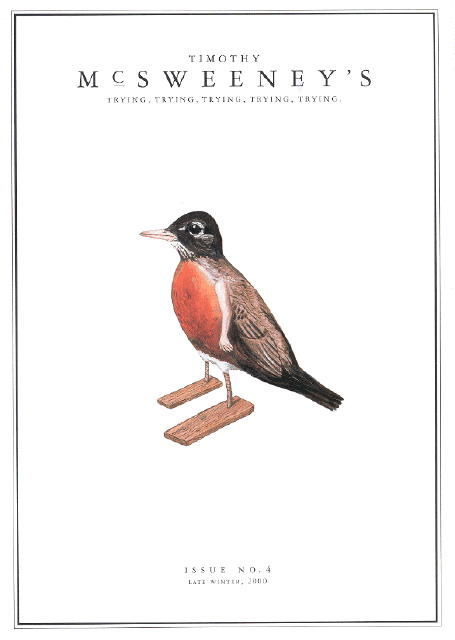
Enough is enough. You cannot change the world with really expensive paper, you cannot revolutionize literature by being “more ironic than McSweeneys” (is that even possible?), and you cannot sell a literary magazine. Literary magazines are not books, no matter how you try to fetishize them, they will never be on the shelf with the novels. They never have and they never will. Literary magazines are the cousins of newspapers. Novels are the cousins of history.

What can we do? I would call for a boycott, I guess, but boycotting literary magazines would be like boycotting sandpaper pants. Nobody’s rushing out to the stores to grab them up anyway. The sad fact is that nature will take its course, and these beautiful, exotic creatures will be eaten by literary evolution. But will anyone survive?

The lumbering giants will survive: The Paris Review, Ploughshares, Triquarterly, etc. These are the litmags you have to get in because they put a big gold star on your resume, and they will survive because of their prestige and tradition. People still want to break their heads open on the editorial boards that published Jack Kerouac, Flannery O’Connor, Samuel Beckett. We’ll eventually be using The Paris Review to line the fork drawer, but not yet.


Which brings us to blogs. Remember zines? Blogs are the new zines. People used to staple together mimeographed pieces of crap in their grandmother’s basement and distribute it via copy machine, coffee shop counter, and word of mouth. They were subversive, populist, and updated instantly on the whim of the publisher. Blogs are the zines of the new millennium – now instantaneous, with open access for all. With all of this magic at the other end of a short wire, is it really worth our time to go around trying to sell paper and glue for ten dollars a glob?

It’s time to stop the presses. I know it’s not easy to pull that plug. Litmags are icons of intellectual privilege. You have to fight against a lifetime of programming that’s telling you literary magazines are good, therefore more literary magazines must be better. You respond out of habit, and assume it’s good news, like when a baby is born. It’s not. Magazines aren’t babies. In the world we live in, we need literary contraceptives. So stop. Put down the telephone. Put down the really nice pen. We don’t need another literary magazine. Literary magazines are dead.